
Kanban in Manufacturing: How Panel Built Uses Lean to Deliver Faster, Smarter
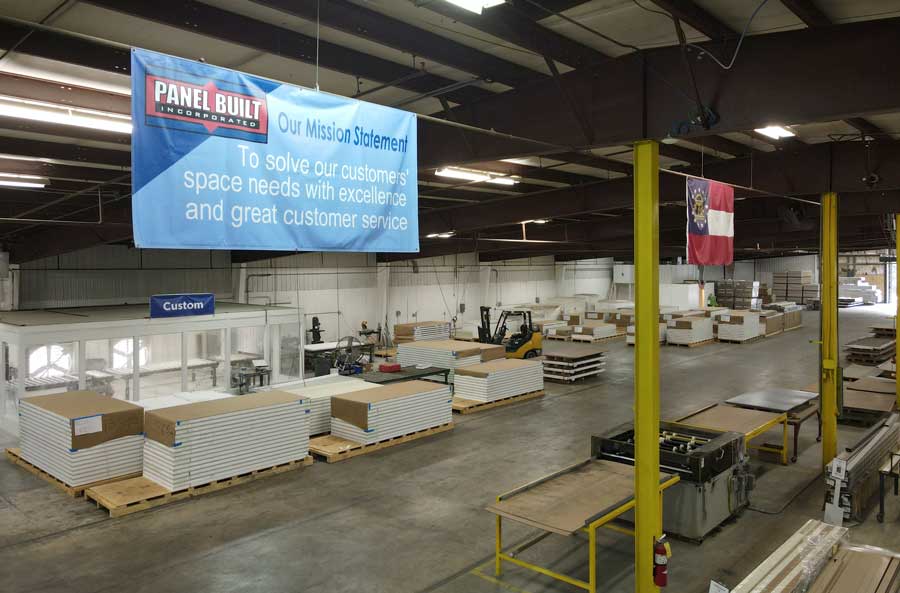
Lean manufacturing isn’t just a philosophy at Panel Built: it’s how we ship quality modular buildings on time, with less waste and more agility. Kanban in manufacturing is one of the core tools that makes our Just-In-Time system work. If you’ve wondered what kanban is, how it supports JIT kanban, and how to apply it on a production floor, this guide breaks it down with practical steps and examples from modular construction.
What is Kanban in Manufacturing?
Kanban is a visual scheduling method that aligns production with actual demand. In a manufacturing kanban system, downstream processes “pull” what they need from upstream processes using simple signals—cards, bins, barcodes, or digital boards—so the right parts show up at the right time and quantity.
Why kanban matters on a modular line
- Minimizes excess inventory and material handling
- Stabilizes flow for repeatable cycle times
- Surfaces bottlenecks quickly with visual work-in-progress limits
- Supports Just-In-Time procurement and fabrication without starving production
Push vs. Pull: A Quick Primer
- Push system: Build to a forecast, push output to the next step or into storage. Risk: overproduction, hidden defects, and slow feedback.
- Pull system: Build only when the next step signals need. Result: lower WIP, faster feedback loops, and fewer surprises.
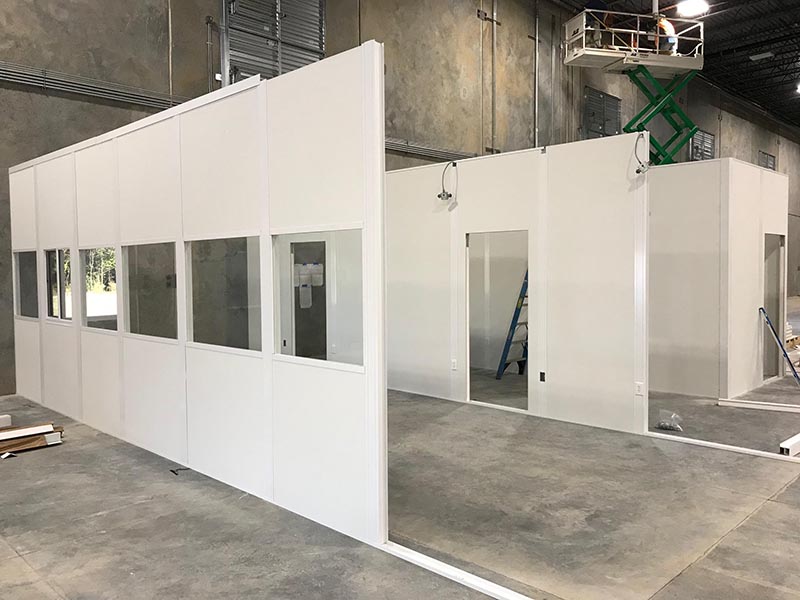
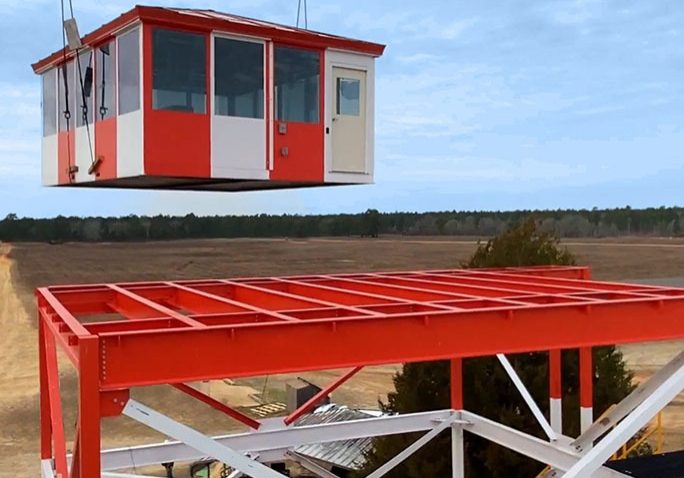
Panel Built’s product mix—custom modular in-plant offices, guard booths, and mezzanine platforms—varies by customer and code requirements. That variability makes pull production a better fit than forecast-heavy push.
Core Elements of a Production Kanban
Kanban signals you’ll see on a factory floor
- Withdrawal kanban: authorizes moving material from supermarket to the next process
- Production kanban: authorizes making a specific quantity to replenish what was withdrawn
- Supplier kanban: triggers external vendors to replenish standard parts
- Signal or triangle kanban: cues batch changeover for high-mix parts
- Emergency kanban: replaces scrapped or defective items without breaking the system
Visual controls that keep everyone aligned
- Kanban board: columns such as To Make, In Process, Inspection, Complete
- WIP limits: hard caps per column to prevent multitasking overload
- Supermarkets: clearly labeled, right-sized buffers with first-in/first-out lanes
- Heijunka box: leveled schedule to smooth demand spikes

Sizing Kanban: How Much is Enough?
Right-sizing cards or bins prevents both stockouts and excess. A simple starting formula many teams use:
kanban cards = (average daily demand × replenishment lead time × (1 + safety factor)) ÷ container size
Practical tips:
- Measure actual lead time, not the plan
- Start with a small safety factor (10–20%) and tune weekly
- Keep container sizes consistent; irregular containers hide problems
Where Kanban Fits in a Modular Plant
Fabrication cells
Cutting, welding, and powder-coat lines respond to production kanban pulled by final assembly. This keeps steel and panel flow matched to current orders.
Assembly and kitting
Modular in-plant office kits are staged in supermarkets. A withdrawal kanban moves a complete kit to a line; a production kanban signals upstream cells to replenish the exact bill-of-materials.
Vendor and MRO parts
Supplier kanban maintains a steady stock of fasteners, glazing hardware, gaskets, electrical components, and filter media that are crucial to keep takt time intact.
Kanban in Lean Manufacturing: Step-by-Step Implementation
- Map the value stream: Identify product families, shared routings, and unavoidable constraints.
- Level the mix: Use small, repeatable pitch sizes rather than big batches to cut lead time.
- Create supermarkets at natural decoupling points: Good places could be during after changeover steps, before external bottlenecks, or near final assembly.
- Define clear card rules: Each card specifies part number, quantity, location, container ID, and replenishment source.
- Set WIP limits and visualize flow: Post limits at cells and on the board. Stop when a column is full, and don’t hide problems.
- Close the loop with daily stand-ups: Review blocked work, shortages, quality alerts, and yesterday’s plan vs. actual.
- Tune relentlessly: Reduce safety factors and WIP as stability improves. Raise issues to root cause, not workarounds.
Common Pitfalls and How to Avoid Them
- Too many part numbers in one loop: Split loops by product family or introduce a signal kanban for slow movers.
- Unreliable suppliers: Use supplier kanban with clear delivery windows; dual-source critical items where practical.
- Ignoring quality at the source: A kanban pulls defects faster. Pair it with standardized work, mistake-proofing, and layered process audits.
- Treating the board as a suggestion: Respect WIP limits. If you exceed them, stop and fix the cause rather than expanding capacity on paper.
Key Metrics for Kanban in Manufacturing
- Lead time and cycle time per product family
- On-time delivery to promise date
- First pass yield and defects per million opportunities
- WIP turns and inventory days on hand
- Plan vs. actual completions at daily pitch
How Panel Built Applies Manufacturing Kanban
- Modular flow cells for frames, panels, doors, glazing, and electrical kits
- Supermarkets feeding final assembly of in-plant offices and booths
- Withdrawal cards for complete kits; production cards for replenishment by cell
- Digital boards at each cell with WIP limits and standardized work instructions
- Supplier kanban on high-use fasteners, grommets, anchors, and gasketing to support JIT kanban without line stops
The result: shorter lead times, fewer shortages, and repeatable quality across high-mix modular projects.
FAQ
1. What is a kanban in lean manufacturing?
It’s a visual signal that authorizes production or movement of a defined quantity, ensuring pull flow and controlled WIP.
2. How does kanban support Just-In-Time?
By triggering replenishment only when downstream consumes inventory, JIT kanban keeps stock low without starving the line.
3. Is kanban only for high-volume lines?
No. With supermarkets and signal cards, kanban works well for high-mix, low-volume environments like modular construction.
Streamlining with Kanban
Kanban manufacturing aligns your production rhythm with real demand. For Panel Built, it’s how we keep modular projects moving—steady, visible, and dependable—without the waste that drags schedules and budgets.
Ready to see kanban in action?
If you’re planning a modular project and value predictable lead times, clean installations, and consistent quality, let’s talk. Request a quote for your next in-plant office, guard booth, or mezzanine, and we’ll show you how our lean manufacturing kanban keeps your job on track.
Call 800-636-3873, email info@panelbuilt.com, or request a quote on our site.
