
Wind-Resistant Bolt-Together Structural Steel Towers
Prefabricated Towers: The Best View From Above
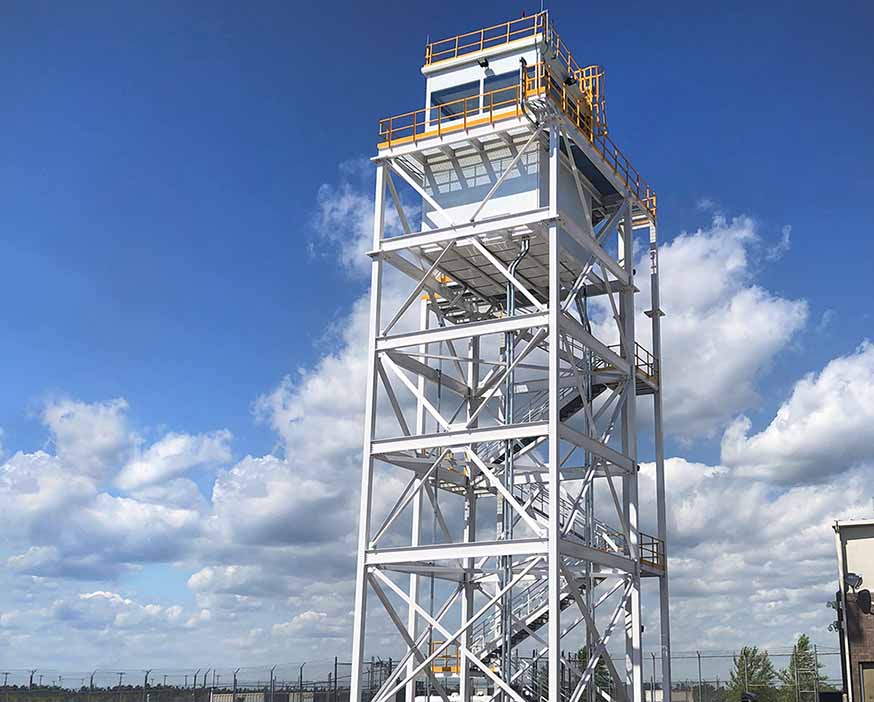
For military testing grounds, coastal airfields, and expanding industrial perimeters, an elevated observation platform must balance two demands: clear 360-degree visibility and the structural rigidity needed to withstand harsh localized forces. The true test of a structural steel tower lies in how it adapts to those environmental variables—surviving 115-mph coastal wind shears, buffering heavy ballistic impacts, or absorbing the continuous dynamic stresses of a platoon running high-velocity rappel drills.
To survive the field, a structure requires an assembly where every vertical column, open-web bar joist, and enclosed operator cab is engineered to transform a high-elevation environment into a controlled, predictable space.
Anatomy of Panel Built Structural Steel Towers
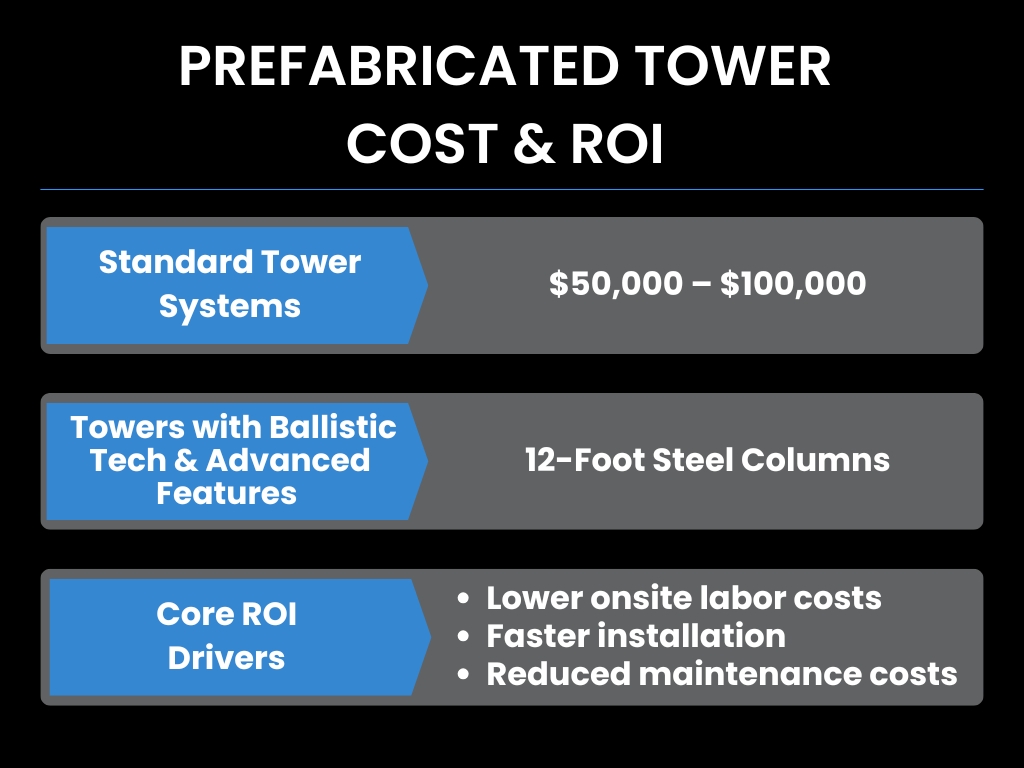
To achieve stability at elevation, a tower system must function as an entirely self-supporting structure without relying on existing walls or building columns for vertical support. By using a bolt-together framework, these systems can be erected, dismantled, and relocated with standard hand tools. Depending on the application, cost ranges for standard configurations typically run from $50,000 to $100,000 per unit, while high-security, ballistic-rated models with advanced features scale from $120,000 to $250,000+.
Because the underlying core framework remains highly rigid, the structure adapts cleanly to a wide spectrum of specialized field configurations:
- Security Infrastructure: Configured as elevated guard towers and surveillance towers, these platforms provide perimeter monitoring across prison and correctional facilities, border checkpoints, and sensitive government infrastructure.
- Tactical Education Hub: Engineered as multi-level rappel towers and open-air training towers, these systems support rigorous dynamic drills for ROTC and JROTC programs, law enforcement academies, and municipal fire departments.
- Defense Overwatch Operations: Deployed as heavy-duty military range towers and sniper overwatches, these configurations provide continuous tactical monitoring and precision training spaces across remote target ranges and active Air Force bases.
The underlying structural steel framing is designed to meet or exceed the strict tolerances outlined in the American Institute of Steel Construction (AISC) Manual of Steel Construction-Allowable Stress Design. When full live loads are applied to the deck, vertical and horizontal deflection across any individual structural component is limited to a maximum threshold of 1/240 of the span.
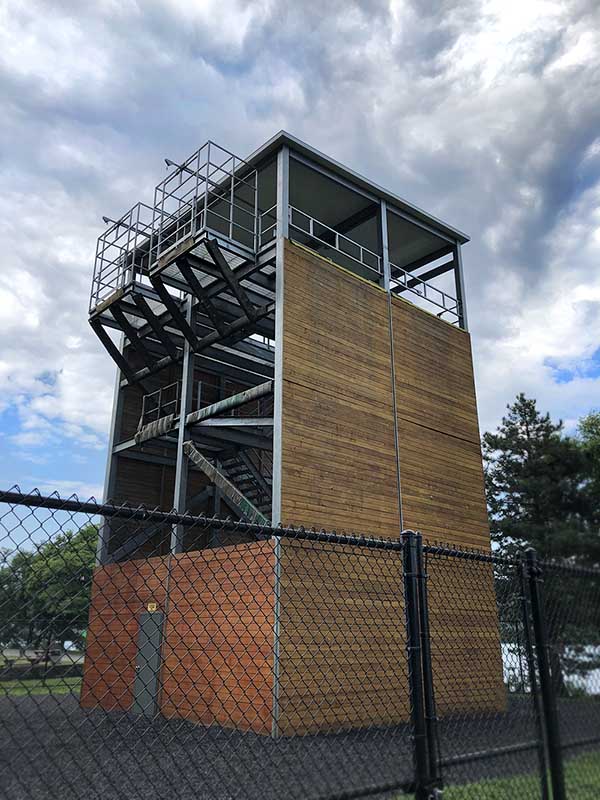
Tower Material Dimensions and Specs
Panel Built’s towers are engineered to withstand environmental forces through tightly controlled steel specifications, including component dimensions and material grades.
- Vertical Columns: The weight of the system is carried by 5” x 5” x 3/16” tubular steel columns. These members conform to ASTM A500 Grade B specifications, which require a minimum yield strength of 46,000 pounds per square inch.
- Foundation Plates: Each support column terminates at a heavy 12” x 12” x 5/8” steel base plate. The plates are anchored to a flat concrete pad using a minimum of four 1/2” diameter anchor bolts.
- Decking Substructure: The elevated platform relies on a foundation of 22-gauge corrugated steel B-Deck with 1-1/2” high corrugations spaced 6” center-to-center. This sub-layer is typically topped with 3/4” tongue-and-groove Advantech, solid ASTM A36 diamond steel plate, or industrial welded steel bar grating held in place with saddle anchors.
Technical Documentation: Detailed engineering and material profiles are available in our Modular Tower Specifications.
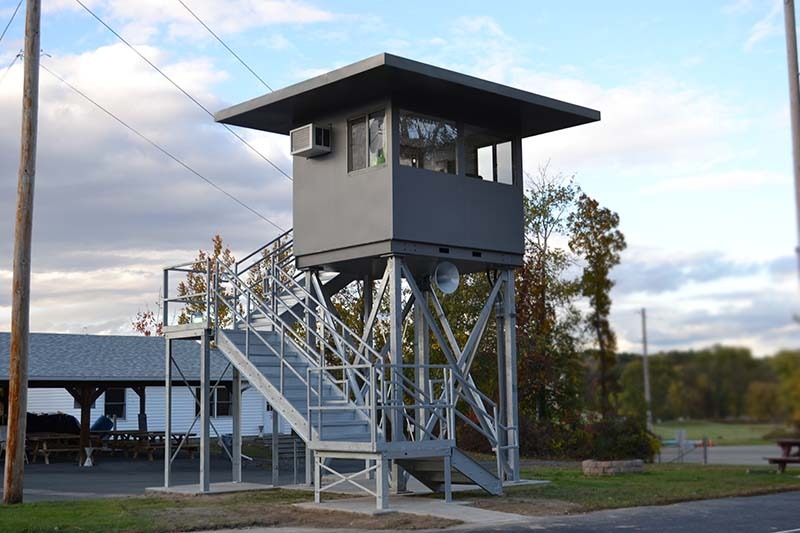
Environmental Adaptation: Cases from the Field
Because these systems are engineered around the specific environmental demands of each site, their deployment across varied terrains offers a clear example of both climate resilience and rapid installation capability.
1. The Airfield Sentinel at Patuxent River
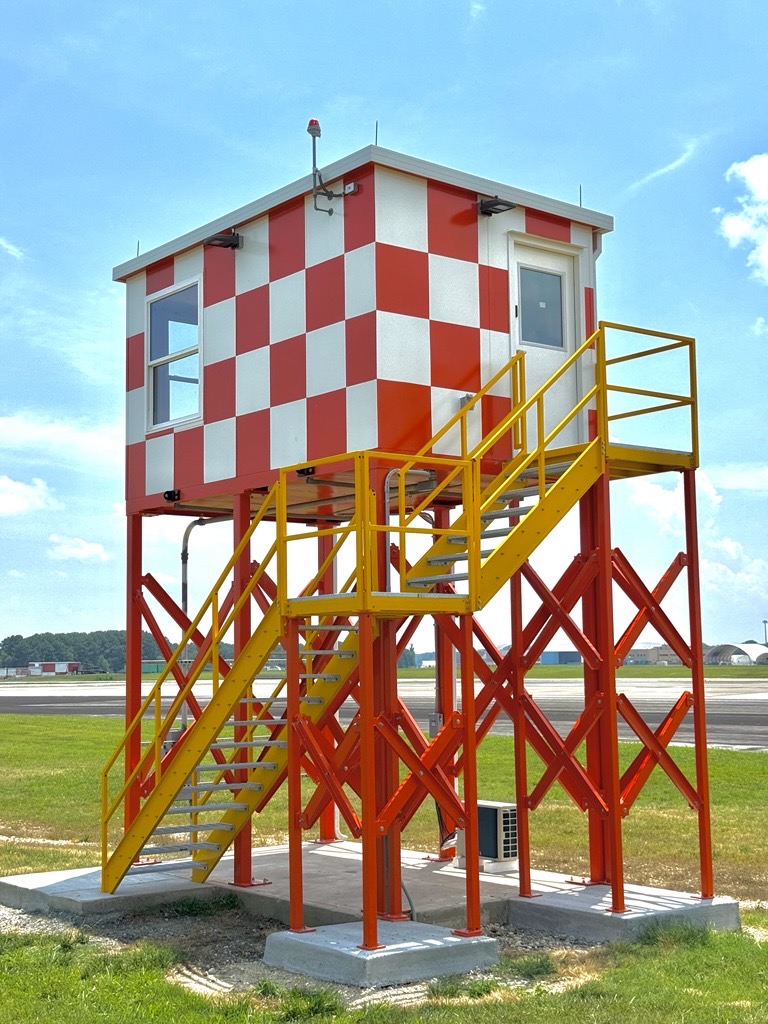
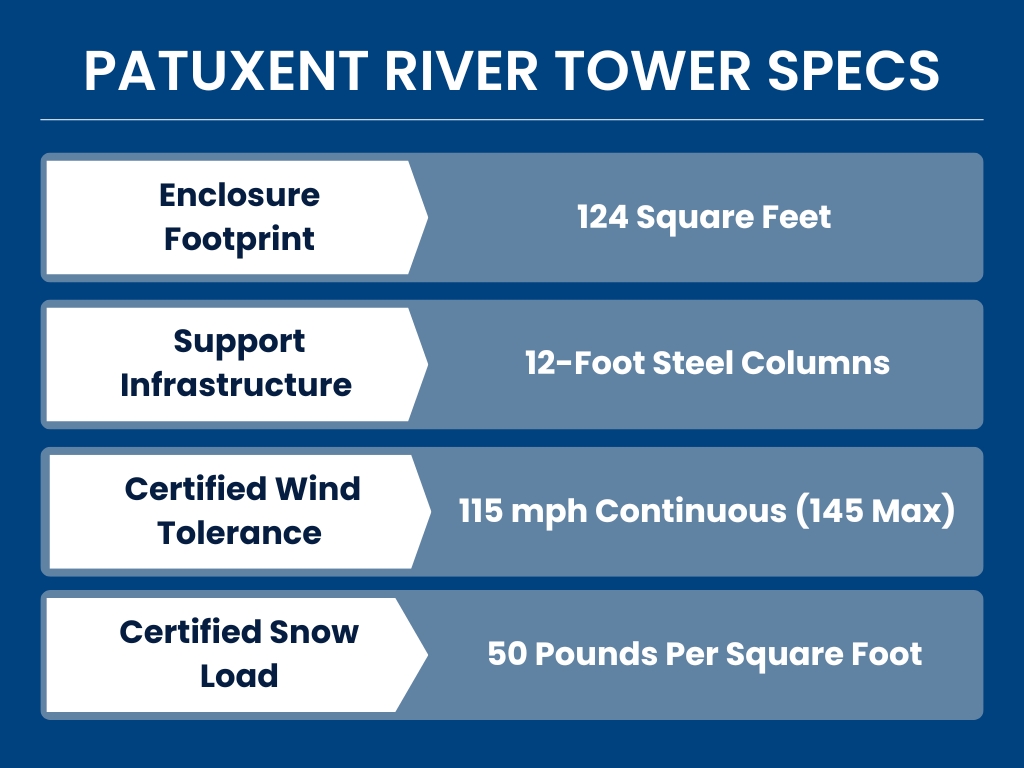
At an airfield installation in Patuxent River, Maryland, a project completed in partnership with Rand Enterprises required an elevated watchtower booth capable of meeting strict visibility standards and severe weather constraints.
The solution integrated a 124-square-foot booth mounted on 12-foot columns to achieve an overall height exceeding 21 feet. To maintain internal climate stability for long-shift personnel, the booth was equipped with a wall-mounted mini-split HVAC system, a forced-air wall heater, and a 200-amp load center to power LED panel lighting and dusk-to-dawn exterior floodlights.
The structural steel was engineered to withstand a continuous 115 mph wind load (based on 145 mph standards) and a snow load of 50 psf. To ensure immediate airfield visibility, the exterior was finished in an orange-and-white aviation checkerboard pattern. For more extreme global climates, custom security enclosures can be configured to withstand wind speeds exceeding 180+ mph.
2. The Pacific Coast Firing Range
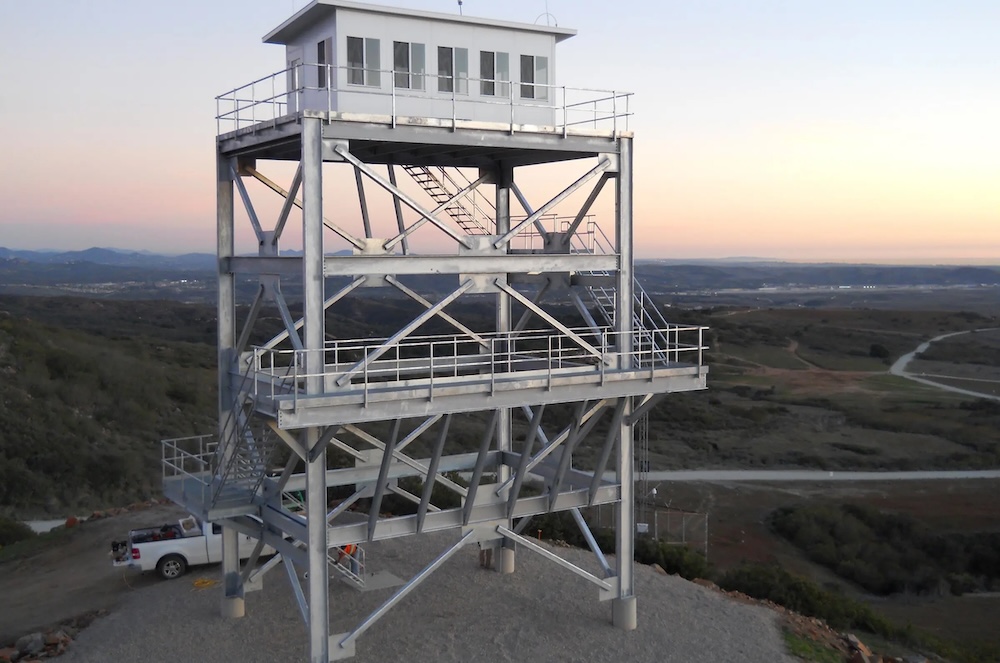
On a mountain ridge overlooking the Pacific Ocean in California, a custom military range tower was deployed to supervise live-fire training exercises. Standing 40 feet tall, the tower supported a 10' x 20' exterior observation building positioned over a 20' x 30' base.
Due to its exposure to coastal wind currents and geographic seismic activity, the structure was engineered to handle Seismic 4 conditions and wind ratings above 90 mph. The project required a 65-ton crane to set the primary steel and bracing, and the installation crew fully completed erection onsite in approximately two weeks.

Tactical Dynamics: Rappel and Training Infrastructure
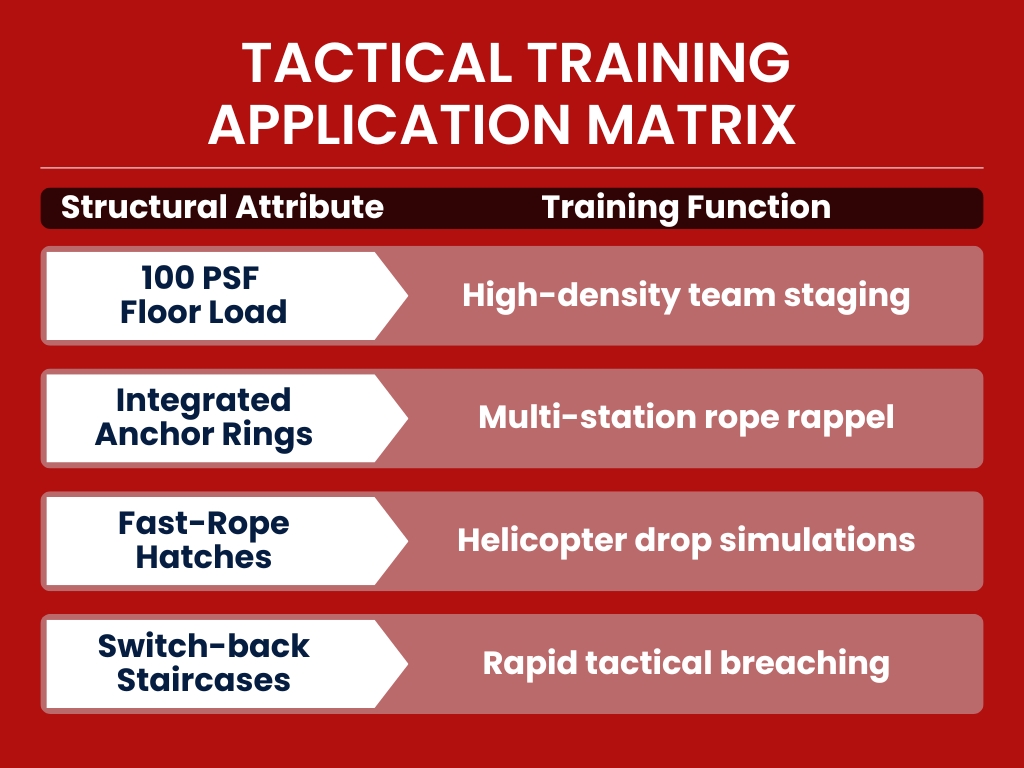
Beyond standard security checkpoints, structural steel frameworks scale to support high dynamic loads for military bases, law enforcement academies, and first responders. These multi-story structures function as controlled environments for technical rope descent, climbing, and sniper training.
Project Spotlight: High-Velocity Training Tower
A practical example of this structural scale is this 67-foot Panel Built rappel training tower delivered through Alpine Towers. The structure features an interior switch-back stair system extending to a covered top-deck canopy, with the columns, beams, and cross-bracing powder-coated in black, and the stairs and railings finished in performance yellow.
To streamline field logistics, the tower used a bolt-together steel connection system. The lower portion was anchored into the ground, while the top section was completely assembled on the ground and crane-lifted into place over the base. This design allows the primary ASTM A36 hot-rolled wide flange beams, along with stairs and landings engineered for a minimum live load of 100 psf, to be installed quickly with minimal onsite structural fabrication.
The Logistics of Offsite Fabrication
By completing the primary engineering and structural fabrication within a controlled factory environment, tower installation becomes far less dependent on the unpredictable variables typically encountered in the field for several reasons:
1. Concurrent Timelines
Traditional construction requires a linear schedule: foundation work must be completed and fully cured before structural materials can be staged or assembled onsite. Prefabricated manufacturing allows these timelines to run in parallel. While field crews prepare and pour the concrete foundation pad onsite, the structural columns, open-web bar joists (meeting Steel Joist Institute K-Series standards), and guard enclosures are manufactured simultaneously inside the factory. When the concrete cures, the pre-engineered components arrive via flatbed, ready for immediate crane placement.
2. Elimination of Field Welding
Because every connection point is engineered, cut, and pre-punched during the factory stage, all field connections are 100% bolted utilizing high-strength J429 Grade 5 structural bolts. This completely removes the need for certified field welding teams, specialized onsite weld inspections, and hot-work permits, controlling both installation risk and overall field costs.

3. Material Resilience
Structures placed in remote or coastal environments face constant exposure to chemical and atmospheric corrosion. To prevent material degradation, every structural member—including beams, columns, landings, and handrails—undergoes a comprehensive factory quality audit before receiving a baked-on powder coat or a heavy-duty galvanized finish. All safety handrails are finished in high-visibility safety yellow to ensure immediate compliance with standard OSHA and IBC workplace safety regulations.
4. Structural Infrastructure Configured to Local Building Codes
Panel Built designs, engineers, and builds custom tower systems to comply with the International Building Code (IBC) and your specific regional seismic and environmental loading requirements. To simplify local municipal permitting and command approval, Panel Built offers final structural drawings certified by a licensed Professional Engineer (PE) registered in the specific state of installation.
Contact a Panel Built Specialist to Review Your Tower Project Specifications