
What Is a Modular Data Center?
When we think about data centers, many of us picture massive concrete facilities packed with thousands, or even millions, of servers. But these hyperscale data centers, which can take months or years to build, simply aren’t capable of meeting every data infrastructure need. Today, computing power is required wherever work happens, from remote construction and mining sites to disaster recovery locations and fast-growing urban areas.
To support rapid growth across a wide range of environments, organizations need data center infrastructure that can be deployed quickly and perform reliably under demanding conditions. When large, site-built data centers fall short on speed, location, or flexibility, operations teams increasingly turn to modular data centers as a faster, more adaptable way to deliver computing capacity exactly where it is needed.
This blog will explore how:
- Modular data centers deliver computing, power, and cooling in prefabricated, relocatable units.
- E-Houses provide the structural foundation for power distribution, control systems, and monitoring equipment.
- Offsite fabrication reduces deployment timelines and improves quality control.
- Modular enclosures support both data center and energy infrastructure, including BESS.
- Scalability and durability are critical for long-term performance in edge and industrial environments.
Defining the Modular Data Center
Before diving deeper, it helps to clarify what we mean by a modular data center.
A modular data center is a prefabricated, self-contained unit that delivers the core functions of a traditional data center in a compact, relocatable form. Sometimes referred to as portable data centers, these systems integrate IT equipment, power distribution, and cooling to support rapid deployment and immediate operation. Because they are built offsite, modular data centers allow organizations to avoid the lengthy development timelines of conventional facilities.
Crucially, modular data centers, like all data centers, depend on a robust enclosure to protect sensitive equipment, manage heat, and safely distribute power. Environmental exposure, wind loads, internal heat generation, and future expansion all place demands on the structure itself, not just the technology inside.
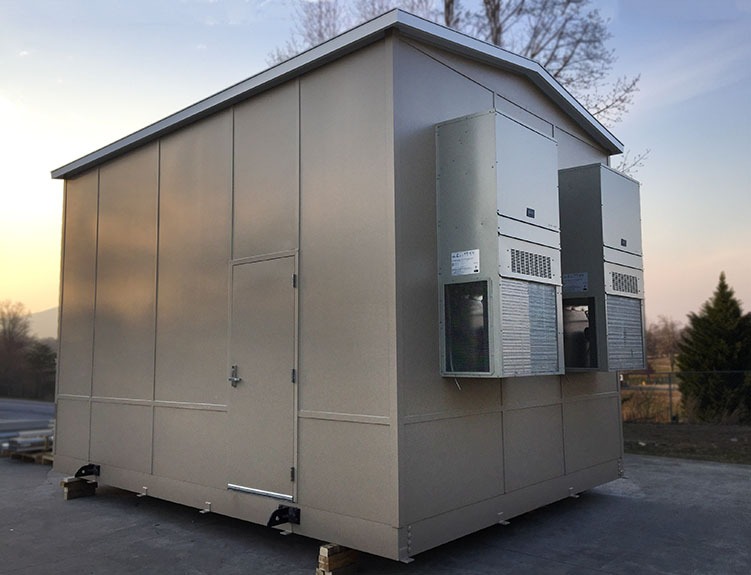
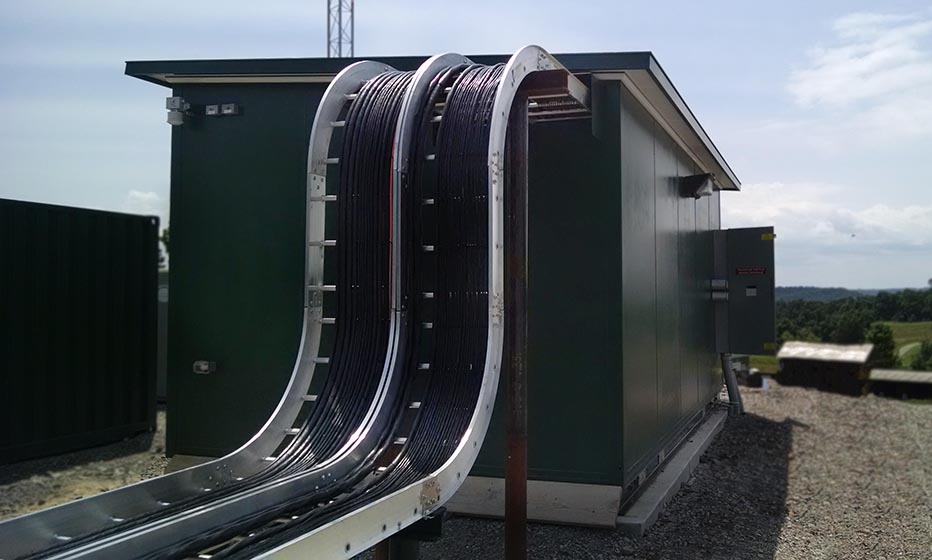
That’s where Panel Built comes in. We custom design and manufacture mission-critical modular data center enclosures, commonly referred to as E-Houses (electrical houses), control buildings, or equipment enclosures, that provide a durable, flexible framework to keep modular data centers operating reliably across varying climates.
E-Houses: The Structural Foundation of Modular Data Centers
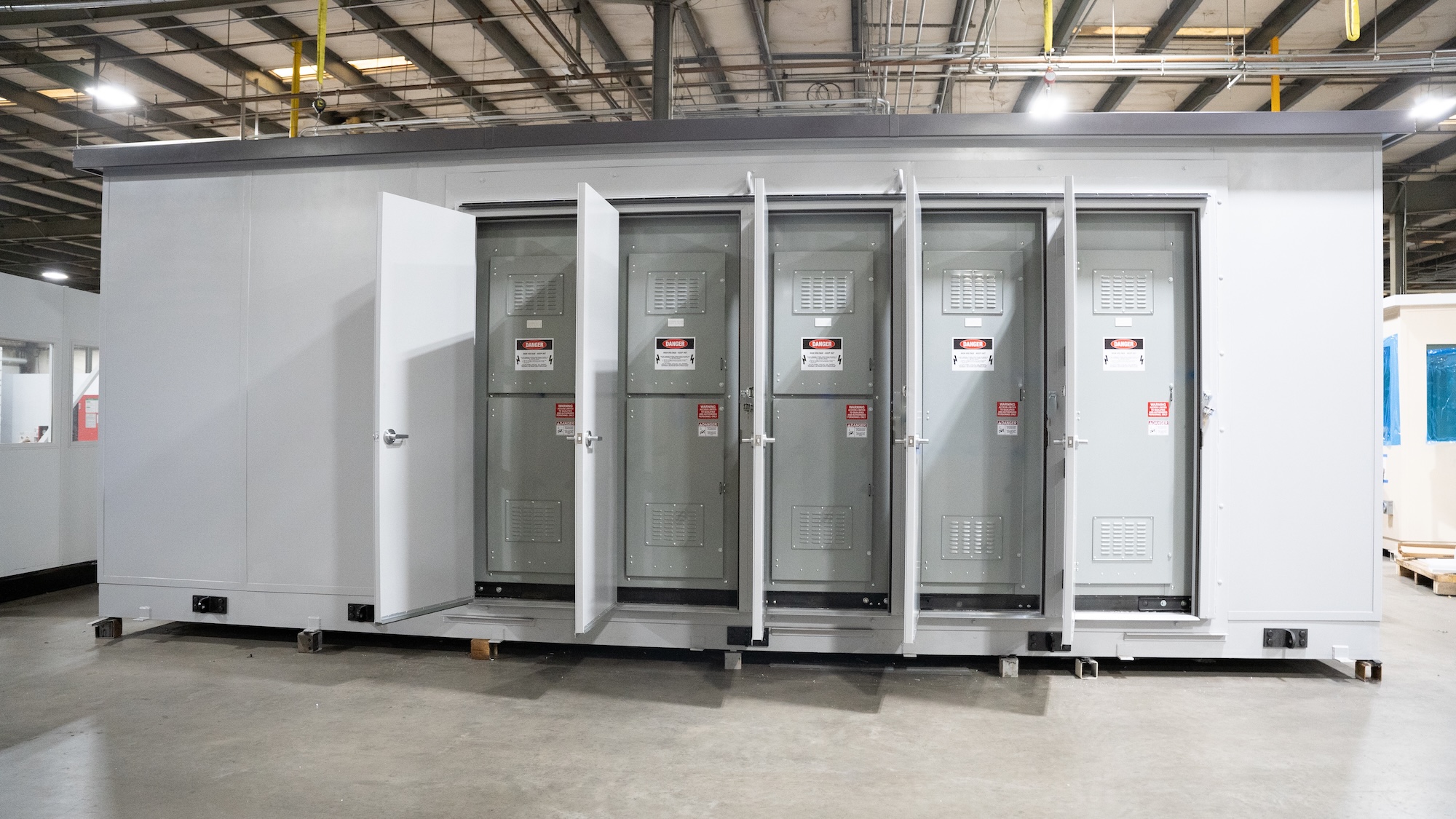
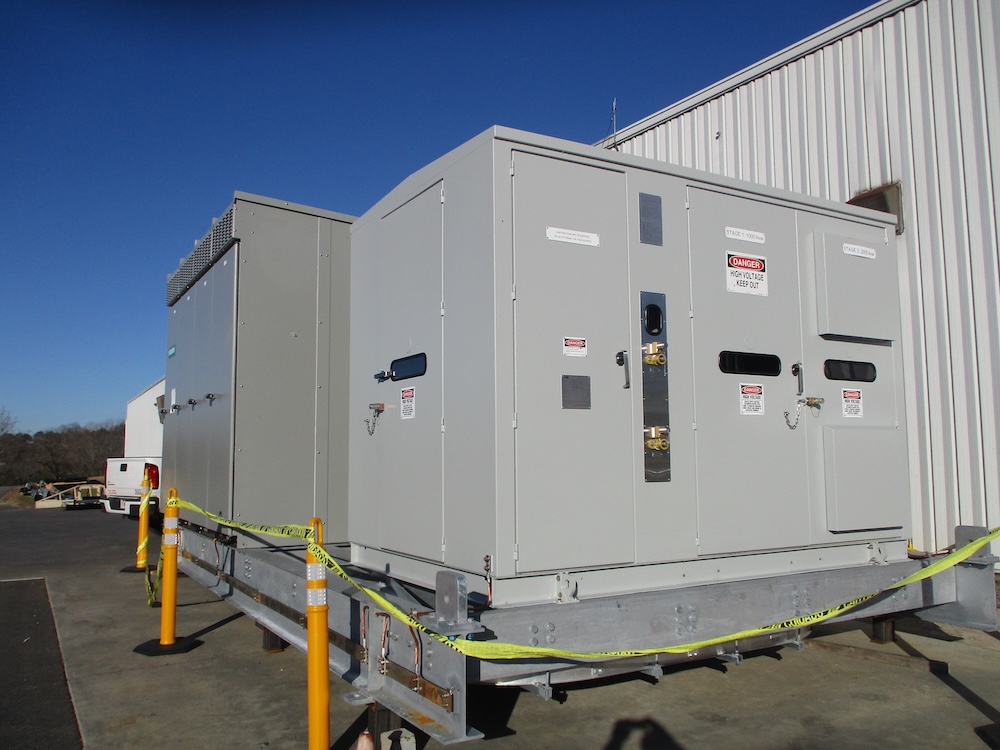
E-Houses are prefabricated, modular structures designed to house the electrical and control equipment that supports data center operations. In modular deployments, they often serve as the centralized location for power distribution, monitoring systems, and control infrastructure that would otherwise require extensive site-built construction.
What E-Houses Typically Contain
An E-House is designed around the equipment it needs to protect and support. Depending on the application, this may include:
- Switchgear, control panels, and relays
- Transformers and motor control centers (MCCs)
- AC and DC panel boards, transfer switches, and termination cabinets
- Battery systems, chargers, and auxiliary electrical rooms
- Monitoring, communication, and control equipment
By consolidating these components into a single prefabricated structure, E-Houses simplify coordination between electrical, mechanical, and structural systems.
Why Modular E-House Construction Matters
Manufacturing E-Houses offsite allows for greater consistency and quality control while reducing installation time in the field. Structural steel frames, insulated wall systems, and standing-seam metal roofs are engineered to handle environmental loads while protecting sensitive electrical equipment.
Modular construction also enables architectural, mechanical, and electrical features to be customized and integrated during fabrication, including:
- HVAC systems sized for internal heat loads
- Interior and emergency lighting
- Cable tray infrastructure and grounding provisions
This approach helps reduce site labor and improves overall schedule predictability.
Flexibility and Mobility
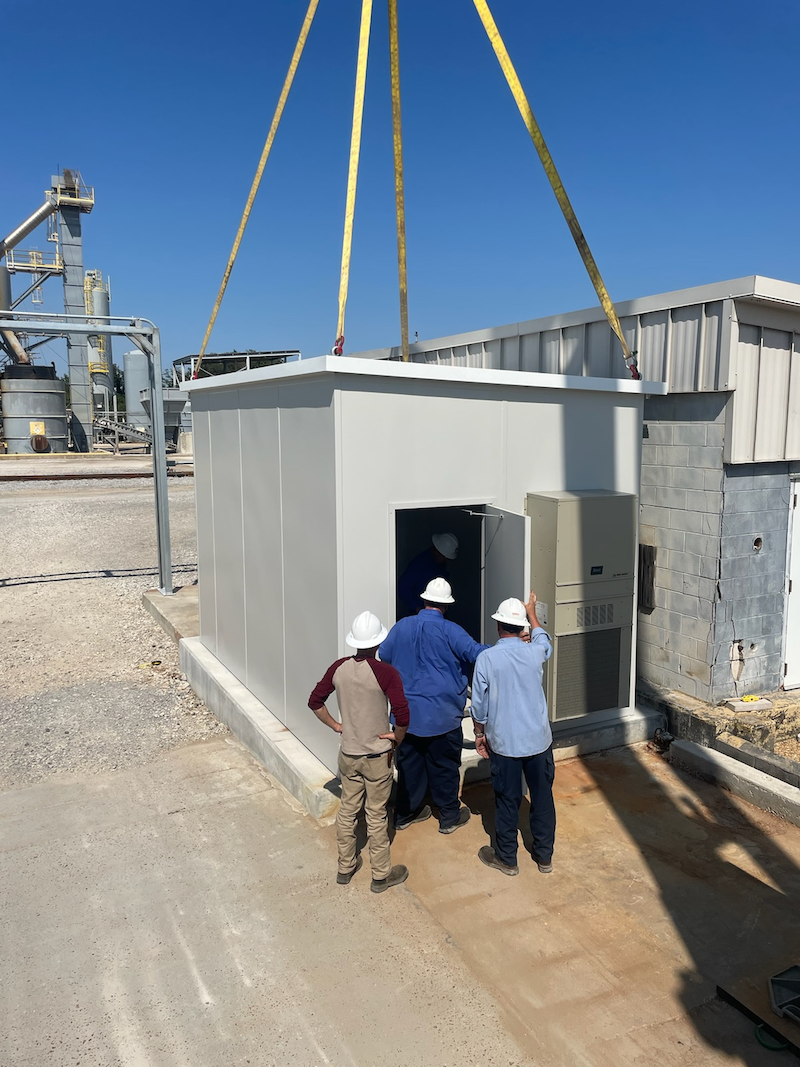
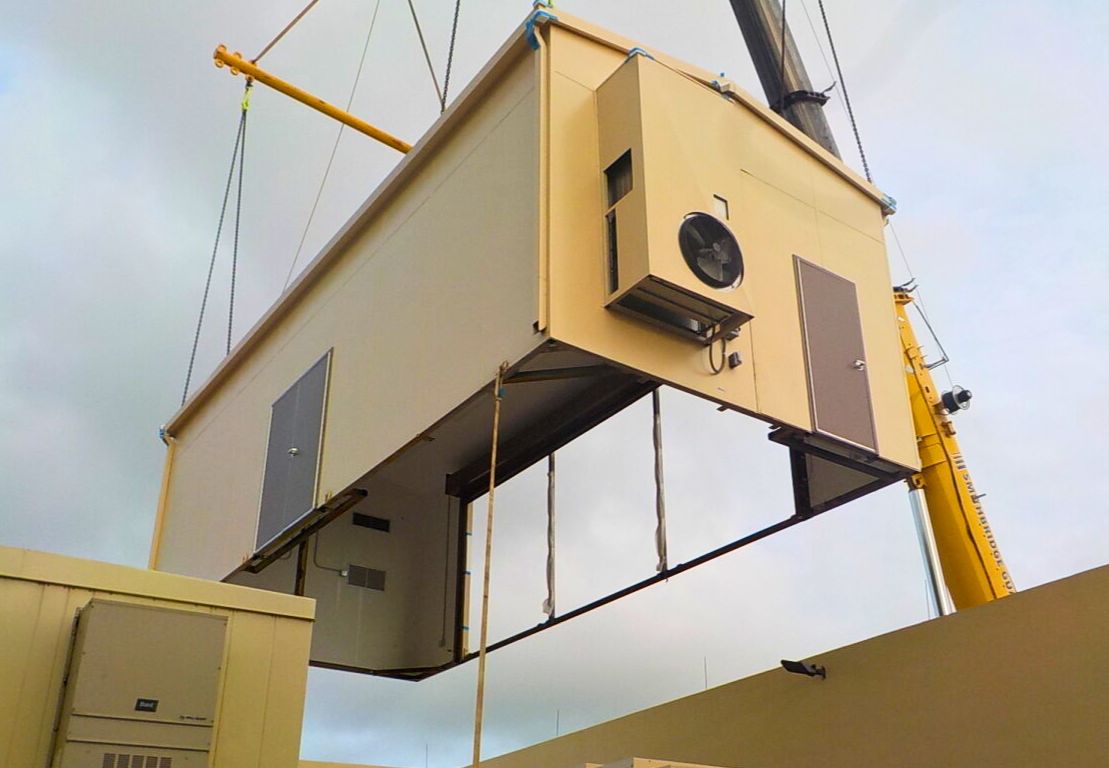
Modular E-Houses are designed to be crane-liftable and transportable, making them suitable for both permanent installations and temporary or phased projects. As operational needs change, these structures can be relocated or redeployed rather than abandoned or rebuilt.
Beyond traditional data center infrastructure, E-Houses also support energy-focused applications, including battery energy storage systems (BESS), where power stability and environmental protection are pivotal.
BESS: Powering Sustainability and Uptime
As data centers and other critical facilities place increasing demands on the electrical grid, energy storage has become a key component of modern infrastructure. Battery Energy Storage Systems (BESS) capture and store electricity for later use, helping stabilize power supply, support renewable energy integration, and maintain uptime during grid disruptions.
Because BESS installations house high-density lithium-ion batteries, enclosure design plays a critical role in system safety and performance. Thermal management, fire protection, and environmental shielding are essential, particularly in remote or harsh environments.
E-Houses and prefabricated electrical enclosures are commonly used to house BESS equipment, providing controlled environments for batteries, inverters, control systems, and supporting electrical infrastructure. Modular construction allows these enclosures to be engineered around site-specific conditions and safety requirements while reducing on-site construction time.
🔺 For a deeper look at how battery storage supports renewable energy and grid reliability, read our blog on how battery energy storage makes renewable power dependable, even when the sun isn’t shining.
Engineered for the Edge: Technical Specifications
Whether deploying a micro data center at the edge of a network or installing permanent infrastructure at a substation, enclosure performance is critical. Modular enclosures must withstand environmental exposure, support heavy electrical equipment, and maintain stable internal conditions over time.
Key design considerations include:
- Structural integrity: Heavy-duty steel bases and frames designed for industrial and outdoor environments
- Load capacity: Floors engineered to support heavy equipment such as UPS systems, transformers, and battery racks
- Wind and weather resistance: Roof systems and wall assemblies designed to handle high wind and snow loads
- Thermal performance: Insulated floor, wall, and roof systems that support efficient cooling
- Security and protection: Options for fire-rated construction, bullet resistance, EMI and HEMP shielding, and secure access systems
These considerations allow modular enclosures to perform reliably where traditional construction may struggle to meet schedule or performance demands.
Key Takeaways
For readers evaluating modular infrastructure options, a few main points stand out:
- Modular data centers offer a practical alternative when traditional construction cannot meet timeline, location, or flexibility requirements.
- E-Houses provide the structural foundation that supports power distribution, control systems, and long-term reliability.
- Offsite fabrication improves quality control and shortens deployment timelines while reducing on-site disruption.
- Modular enclosures support both computing and energy infrastructure, including BESS applications.
- Designing for durability, scalability, and future expansion is essential for long-term performance.
As data and energy demands continue to evolve, modular data centers and prefabricated enclosure systems provide a scalable, resilient path forward.
Frequently Asked Questions About Modular Data Centers
Q: What is a modular data center?
A: A modular data center is a prefabricated, self-contained unit that integrates IT equipment, power distribution, and cooling. These systems are designed for rapid deployment and can be installed where traditional data center construction is impractical.
Q: What is an E-House?
A: An Electrical House, or E-House, is a modular enclosure used to house power distribution, control, and monitoring equipment. In modular data center deployments, E-Houses often serve as the central hub for electrical infrastructure.
Q: How are modular data centers different from traditional data centers?
A: Traditional data centers are typically built on site and require long construction timelines. Modular data centers are fabricated offsite and delivered ready for installation, reducing deployment time and improving flexibility.
Q: Can modular data centers support battery energy storage systems (BESS)?
A: Yes. Modular enclosures and E-Houses are commonly used to house BESS equipment, providing the thermal management, fire protection, and environmental shielding required for safe operation.
Q: Are modular enclosures suitable for harsh or remote environments?
A: Modular enclosures are designed to withstand demanding conditions, including high wind loads, temperature extremes, and remote locations where on-site construction is challenging.